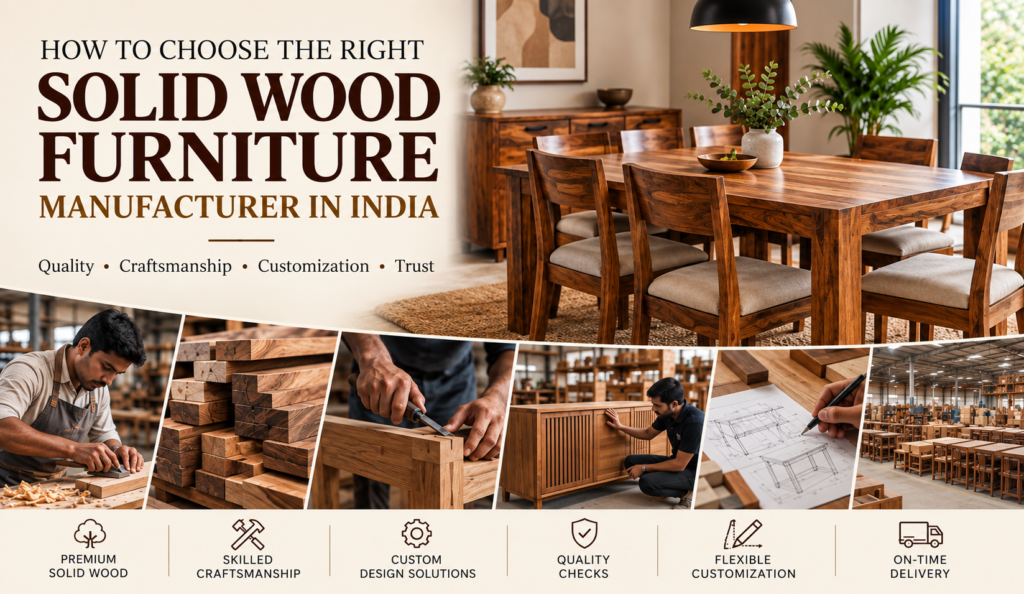
Furniture is one of the few purchases that has to work on two timelines at once: it needs to look right today, and it needs to hold up for the next decade. That’s a harder balance than it sounds, especially when searching for a solid wood furniture manufacturer in India, where the market ranges from small local workshops to large export-grade factories — all promising “premium quality” and “custom design.”
So how do you actually tell a genuine furniture manufacturer in India from one that just looks good on Instagram?
The honest answer is: not by browsing a catalogue. It’s by asking the right questions about wood, construction, customization, and production control — and knowing what a good answer sounds like. This guide walks through exactly that, using Purewood, an Indian furniture manufacturer and exporter operating since 1997, as a reference point for what a serious wooden furniture manufacturer in India looks like in practice — whether you need solid wood furniture in India for a home, a hotel, or a full commercial fit-out.
Why Solid Wood Still Wins
Trends in furniture come and go — but solid wood has stayed relevant for a simple reason: it ages well. Engineered materials can look sharp on day one, but they rarely improve with time. Solid wood does. The grain deepens, the finish develops character, and a well-built piece can outlast several rounds of interior redesigns around it.
That’s true whether you’re furnishing a home or a 200-room hotel. The difference is what “well-built” needs to mean in each context — a dining table built for a family of four has very different demands than a chair that gets used twelve hours a day in a restaurant.
What to Actually Check Before You Buy
1. The Wood Itself
Not all solid wood behaves the same way, and any credible wooden furniture manufacturer in India should be able to explain the trade-offs without prompting.
Purewood’s range of wooden furniture in India includes mango wood, acacia, sheesham, oak, pine, and ash — each suited to different uses. Sheesham, for instance, is dense and holds intricate detailing well, which is why it’s common in traditional Indian furniture. Oak brings a lighter, more contemporary look and handles heavy daily use well, making it a common choice for hospitality projects. Mango wood sits in between — affordable, workable, and increasingly popular for mid-range residential furniture.
The right wood depends on your furniture type, how it’ll be used, your interior style, and your budget — in that order. A manufacturer that recommends the same wood for every project regardless of context probably isn’t thinking about your specific use case.
2. Track Record, Not Just Portfolio Photos
Photos show you what a manufacturer can produce under ideal conditions. They don’t show you whether that quality holds up at scale, under deadline pressure, or on order fifty of five hundred.
This is where experience matters more than most buyers initially weight it. Among furniture manufacturers in India, Purewood has been producing furniture since 1997, which means its production systems — sourcing, machining, quality checks — have been stress-tested across residential, commercial, hospitality, and export orders for nearly three decades as an established furniture exporter in India.
The practical question to ask any furniture manufacturer and supplier in India isn’t “how long have you been in business” as a trivia fact — it’s “have you handled a project of this size and complexity before, and can I see it?”
3. Customization That’s Actually Custom
A lot of manufacturers claiming to be a custom furniture manufacturer in India actually mean “we’ll paint it a different color.” Real custom wooden furniture in India goes deeper: dimensions built around your actual floor plan, finishes matched to an existing palette, and designs adapted to a specific brand or aesthetic.
This matters most for:
- Homes with non-standard room dimensions or layouts
- Hotels and resorts maintaining a consistent design language across every room
- Restaurants and cafés where furniture needs to reflect a specific brand identity
- Interior designers translating a concept into physical, deliverable furniture
If you’re going the custom route, come prepared with accurate measurements, reference images, preferred materials, and a realistic sense of quantity and timeline. The more specific your brief, the better the outcome — vague requests produce vague furniture.
Furniture for the Home
For homeowners working with a residential furniture manufacturer in India, solid wood furniture typically covers:
- Dining tables and chairs
- Beds and headboards
- Wardrobes and cabinets
- Sideboards and coffee tables
- TV units and storage furniture
The best approach here is to think about the room as a system rather than buying pieces individually. A dining table chosen in isolation might look great in a showroom and completely wrong once it’s sitting next to your existing sideboard. Consider scale, finish consistency, and daily usage patterns (a family with young kids has different durability needs than a couple who entertains occasionally) before finalizing anything.
Furniture for Hotels, Restaurants, and Cafés
Commercial furniture manufacturers in India operate under a different set of pressures than residential ones. Furniture gets used more often, by more people, with less care — and it needs to look consistent across dozens or hundreds of units, not just one room.
A capable hospitality furniture manufacturer in India should offer a full range across categories. Purewood’s hospitality line, for instance, covers chairs, tables, sofas, beds, and booths built for hotels, restaurants, cafés, and bars — making it a working example of what a restaurant furniture manufacturer in India, hotel furniture manufacturer in India, or café furniture manufacturer in India.
should be able to deliver. But the category matters less than the checklist behind it. Before placing a commercial order, get clear answers on:
- Material specs — is the wood treated for the environment (humidity, foot traffic, spills)?
- Construction quality — joinery type, load rating, warranty terms
- Consistency at volume — how do they guarantee unit #400 matches unit #1?
- Production capacity and timeline — realistic lead times, not best-case estimates
- Packaging and delivery — especially relevant for multi-city or international shipping
For a 150-seat restaurant or a 100-room hotel, small inconsistencies across units compound fast. This is the single biggest reason hospitality buyers should prioritize manufacturers with proven bulk-order experience over ones that only show single-piece showroom work.
Why In-House Manufacturing Actually Matters
“In-house manufacturing” sounds like a checkbox term, but it has a concrete, practical benefit: control. When machining, assembly, finishing, and inspection all happen under one roof — as Purewood structures its production — there’s no handoff between separate vendors where specifications can drift or quality can slip.
For a one-off residential order, this might not matter much. For a custom hospitality order of 300 identical chairs, it’s often the difference between a shipment that matches the approved sample and one that doesn’t.
Ordering in Bulk: What to Ask a Wholesale Furniture Manufacturer
Hotels, retailers, developers, and interior design firms ordering at scale need a wholesale furniture manufacturer in India that can handle volume without sacrificing consistency. A capable bulk furniture manufacturer in India should treat your first conversation like a diligence call, not a sales pitch. Useful questions include:
- What’s your minimum order quantity, and does it change per product line?
- Can I get and approve a physical sample before the full production run?
- What’s your realistic production timeline for this order size — and what’s the buffer if something slips?
- How do you inspect quality before dispatch, and can I see your QC process?
- What does packaging and shipping look like for an order this size?
- Do you handle installation, or is that on us?
A manufacturer that answers these clearly and specifically — with real numbers, not reassurances — is telling you something important about how they run production.
Quick Reference: Questions Worth Asking Any Manufacturer
- Which types of wood do you work with, and why would you recommend one over another for my use case?
- What can and can’t be customized?
- Is production in-house or outsourced to third parties?
- What’s your experience with bulk or hospitality orders specifically?
- What finishing options exist, and how do they affect maintenance?
- What does your pre-dispatch inspection actually check for?
- What’s the honest production timeline, not the optimistic one?
- How is furniture packaged for transit?
- Do you have experience in my specific segment — residential, hospitality, retail?
- What happens if something arrives damaged or doesn’t match the sample?
Where Purewood Fits
Purewood is an Indian furniture manufacturer and exporter with a broad catalogue: solid wood furniture and wooden furniture, industrial furniture, cane and rattan pieces, upholstered furniture, and a dedicated hospitality line covering restaurants, cafés, bars, and hotels.
What’s worth evaluating specifically is the combination of factors covered above — multiple wood options, in-house production control, nearly three decades of manufacturing experience, and stated capacity for both custom and bulk orders. None of that guarantees the right fit for every project, but it’s a reasonable shortlist of things to verify directly with them if you’re considering a residential or commercial furniture order in India.
Frequently Asked Questions
What is solid wood furniture? Furniture built primarily from natural, unprocessed wood rather than engineered materials like MDF or plywood. Its durability and appearance depend on the wood species, construction method, and finish.
Which wood is best for furniture in India? There’s no universal answer. Sheesham suits detailed, traditional designs; oak handles heavy commercial use well; mango wood offers an affordable, versatile middle ground. The right choice depends on your furniture type, usage, and budget.
Can I get custom solid wood furniture made in India? Yes — most established manufacturers offer customization on dimensions, finish, and design, particularly useful for hotels, restaurants, offices, and homes with non-standard space requirements.
Is solid wood furniture durable enough for hotels and restaurants? Yes, provided the wood species, joinery, and finish are matched to commercial-use conditions. Not all solid wood furniture is built for high-traffic environments, so this is worth confirming before ordering.
How do I actually compare furniture manufacturers in India? Look past price and photos. Compare wood quality, in-house production control, bulk-order track record, quality inspection process, and how clearly they answer specific questions about your project.
The Bottom Line
The manufacturer you choose affects your furniture far more than the specific piece you pick from a catalogue. Two identical-looking dining chairs from two different manufacturers can age completely differently depending on wood quality, joinery, and finish — and you won’t see that difference until year two or three of ownership.
Before committing, get specific: ask about wood, ask about production control, ask about their bulk-order history if that applies to you, and ask for a sample before a full run. A manufacturer that answers plainly and specifically is usually the safer bet — regardless of which one you ultimately choose.